The Saga of Narveer Tanaji's Bravery - नरवीर तानाजींची शौर्य गाथा
Dedicated to Shri Chhatrapati Shivaji Maharaj and his brave comrades
श्री छत्रपती शिवाजी महाराजांना आणि त्यांच्या वीर सहकाऱ्यांना समर्पित
Rarely in the world has such a campaign been planned and successfully executed... Historians have written many commentaries on this campaign. The memory of Tanaji Malusare's supreme sacrifice immortalizes this climbing battle through the saying 'Gad aala pan Sinha gela' (The fort is won, but the lion is lost), along with ballads and stories... This presentation has been structured by current expert military officers from the Army, Air Force, and Navy. The purpose of this presentation is not to point out the mistakes in the battle fought by the Maharaj. This research is based on the premise of how today's military officers would plan and execute this campaign, keeping in mind the limitations of that era, if ordered from a military strategy perspective. The aim is to give an idea of how military forces have to analyze from various angles, how they prepare, and how they have to adapt according to the situation while actually carrying out the operation.
जगात अशा तऱ्हेची मोहीम फारच कमी वेळा आखली व फत्ते केली गेली असेल... इतिहासकारांनी या मोहिमेवर अनेक भाष्ये केली आहेत. 'गड आला पण सिंह गेला' या उक्तीतून, पोवाडे व कहाण्यातून तानाजी मालुसरेंच्या जीविताच्या आहुतीची आठवण या चढाईच्या लढतीला उदात्त करून जाते... सध्याच्या भूदल, हवाईदल आणि नौदलातील तज्ज्ञ लष्करी अधिकाऱ्यांनी केलेली ही मांडणी आहे. हे सादरीकरण करण्याचा उद्देश महाराजांनी जी लढाई केली त्यातील चुका दाखवायचा नाही. युद्धशास्त्रीय दृष्टीकोनातून आजच्या लष्करी अधिकाऱ्यांना जर आज्ञा मिळाली, तर त्या काळातील मर्यादा लक्षात ठेवून ते ही मोहीम कशी नियोजित करतील आणि कशी पार पाडतील या प्रमेयावर हे शोधकार्य आधारित आहे. लष्करी दलांना विविध अंगांनी विश्लेषण करून कसे नियोजन करावे लागते, पूर्वतयारी कशी करतात, प्रत्यक्ष पार पाडत असताना परिस्थितीनुसार कसे फेरबदल करावे लागतात, याची कल्पना यावी हा उद्देश आहे.
Looking Back... The Beginning and Planning of the Campaign
According to Major General Shishir Mahajan, due to the Treaty of Purandar, Shivaji Maharaj himself handed over Sinhagad (Kondhana) to Kiratsingh on June 14, 1665. While taking a review of the surroundings from Rajgad, Sinhagad remained an eyesore for Maharaj until February 3, 1670. The campaign started on February 4 (the night of Magh Vadya Navami). Tanaji Malusare was a staunch commander of five thousand infantry of Maharaj, and he voluntarily took the responsibility for this campaign. He planned an innovative but highly risky campaign to launch an overnight attack by taking the Mavlas from an unexpected location.
Shivaji Maharaj's Planning
According to Shivaji Maharaj's plan:
• Companies "A" and "C" were to attack the guards at the two ends of the cliff and inside.
• Before that, at least 300 Mavlas should be ready after climbing the cliff.
• The remaining Company "B" was to protect and assist 50 of their men to open the Kalyan gate from the inside.
• To draw Udaybhan out of the citadel and kill him.
• The advisory committee for this campaign included Yesaji Kank, Moropant Pingle, and Shelar Mama.
Why was Tanaji Malusare Given the Leadership of this Campaign?
According to Lieutenant General Dattatraya Shekatkar:
• Tanaji knew Sinhagad inside out.
• Being an infantry commander, Tanaji had the capability to raise a standing army of one thousand soldiers.
• Tanaji must have known Udaybhan's face and stature from having seen him earlier, and knowing exactly who to kill is very important.
• And most importantly, Shivaji Maharaj had immense trust in him.
Compilation of Bahirji's Intelligence
According to Lt. General Rajendra Nimbhorkar, the information gathered through Bahirji's spies was as follows:
• Troop strength, shift changes on the watchtowers, and the locations and numbers of guards.
• The number of guards at the 3 gates on the Kalyan village side was at least 30. Door number 2 was defective, as it could not be locked from the inside but could be closed.
• The Pune gate side was strongly secured from the inside with wooden logs.
• It was possible to infiltrate by claiming that the rope ladders and tethers were for the animals.
• The local Mavlas, who had traditionally managed the outer security of the fort's perimeter, could be won over by giving them gold bracelets.
• Between Kalavantini and Zunjar Buruj (current names), 4 new night patrol posts of 2 men each were set up from inside the ramparts for various commanders' troop detachments in weekly double shifts.
• There were always 3 guards present at the commanders' houses, and during the night shift, there were at least 50 to 70 soldiers. After 2 AM, they were mostly off guard.
Preparations and Secrecy
According to Lieutenant General Venky Patil, the following points were noted during Tanaji's survey:
• A tiger had not been seen in the jungle for the past few weeks. At night, deer, hyenas, and jackals roam around.
• Wild dogs and boars come to eat discarded leftover food.
• With the help of trappers, they searched for and destroyed cobra and snake holes, ant hills, and wasp nests.
• They cut down the prickly, itchy bushes of Karvi and Ghaneri.
• They gathered information from the stable keepers about what Udaybhan currently looks like, what he wears, how many bodyguards he has, and who they are.
According to Brigadier Hemant Mahajan:
• There was a significant increase in Udaybhan's Mughal soldiers on the fort, and they were on high alert due to the news of the broken treaty with Aurangzeb.
• Bundles of ropes sent under the pretext of tying animals and fodder had reached the fort.
• Two out of four men had gone up carrying white cloth to make the ropes visible in the dark at night by tying them to strong rocks and tree trunks along the cliff edge.
According to Commodore Shrikant Deshmukh (Navy):
• 1100 swords with hilts, sheaths, and sharpened edges, as well as tested shields, were ready.
• Jute ropes, rope ladders with cords, flintstones, smoke-producing salammoniac, oil-soaked rags to light fires, bandages for the wounded, Nirgudi leaves, and ointments were prepared.
• A rumor was spread that a wedding procession would be traveling on the road from Rajgad to Sinhagad.
Donagiri Cliff and Time Management
According to Lieutenant General Satish Satpute, because it was difficult to climb from the valley side of the Donagiri cliff, this area was neglected by Udaysingh's army. Once climbed, there was a hollow area convenient for hiding, and it was a convenient route to head towards the Kalyan gate.
According to Lt. General Sanjay Kulkarni, war stands on two pillars: 'speed and time'. If the required climbing height is considered to be around 15 meters, and initially, 10 men can climb Donagiri in 20 minutes using 2 rope ladders dropped from above. If 60 soldiers can climb in the first hour, and by increasing the number of rope ladders to 6 in the next 3 hours, 90 soldiers per hour can climb, making it 270 + 60 = 330, then the planning for the next phase can be done.
According to Air Marshal Bhushan Gokhale, 2 to 4 AM is the time of deep sleep. Since there were no watches then, the time of the attack must have been decided based on the speed and visibility of the moon. The moon on the night of Ashtami comes overhead after 12. Once it became visible on the side of the Donagiri cliff, it was to be understood that if 200 soldiers had reached the top, the attack should begin once another 100 had climbed.
Tanaji's Army and Yashwanti the Monitor Lizard
Air Marshal Sunit Soman imagined the orders given to Tanaji's army : "O brave Mavlas, we have to bring Kondhana back under the authority of our kingdom... Even though we are less than a thousand in total, we are more than a match for the more than 1500 enemies."
Regarding the Yashwanti monitor lizard, it is mentioned that a monitor lizard can be up to 5 feet long and weigh up to 50 kg. However, since it is a moody animal, relying on it for any planning was risky, and bringing it from 45 km away was not practical. Therefore, the likelihood of using the Yashwanti monitor lizard in this campaign is low.
Astute Warfare Tactics
According to Major General Amardeep Bhardwaj, 'Manoeuvre Warfare' (Astute Warfare Tactics) was used in this battle. In this fight, tactics like checkmate, creating confusion, deceiving, and winning the battle by making a massive hidden attack were used. He considered Shivaji Maharaj as one of the renowned military commanders in the world and gave him 9 out of 10 marks.
The Actual Operation
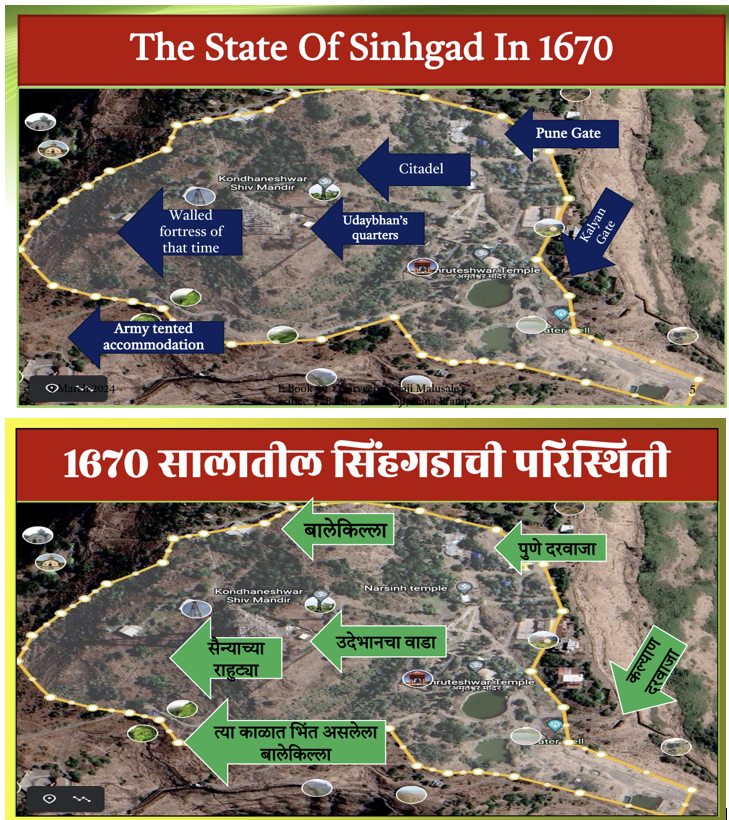
On the night of February 3/4, 1670, Tanaji Malusare reached the base of the fort with 500 Mavlas. Companies 'A', units 1 and 2 cleared the guards and secured Hanuman Gadhi. The task of Company 'C' was to establish Tanaji's observation post.
Units 2 and 3 of Company 'A' beat the animals (horses, bulls) and made them run towards the soldiers' tents. Suddenly, a 'stampede' was created. Before the sleeping Mughals could understand what happened, the animals barged into the tents. Unit 3 set fire to the haystacks using the oil-soaked rags they had brought. Seeing the flames rising suddenly, the Mughal army rushed there.
Meanwhile, Company 'D', with about 200 Mavlas, came up from the Hanuman Gadhi side. The Mughal soldiers were trapped like a 'chicken neck' in the narrow gap between the citadel ramparts and the ravine. Tanaji blocked Udaybhan's fleeing soldiers in this narrow path.
Kalyan Gate and Udaybhan's Entry
Company 'B' started the task of opening the Kalyan gate from the inside. The Mughal guards threw the bunch of keys into the dark, leaving no option but to break the door. Suryaji was waiting outside the Kalyan gate with 500 Mavlas.
When Udaybhan received the news of the chaos, he came out with his bodyguards. Seeing the door locked from the outside, he ordered his army to be ready to fight from the inside.
As the door did not open, the Mavlas grew anxious. Tanaji encouraged them: "O braves, the time has come for a heroic death... I know them. Don't be afraid at all... As long as I am here, I won't let anyone die". Finally, the door opened, and with the roar of 'Har Har Mahadev', Suryaji's 500 soldiers entered.
Tanaji and Udaybhan: Hand-to-Hand Combat
In the light of the torches, Tanaji and Udaybhan came face to face. Their swords clashed. Udaybhan changed his stance and held his sword in his left hand. Because Tanaji had practiced with right-handed fighters, his calculations started to fail. At the crucial moment, the straps of the handle of Tanaji's shield became loose. Udaybhan's blow landed on Tanaji's left arm, and he lost his balance and fell. Suryaji rushed to help. As Udaybhan's attention was diverted, Tanaji quickly got up and struck a powerful blow, bringing Udaybhan down. But while falling, Udaybhan's sword blow hit Tanaji's chest.
The Fort is Won, But...
Tanaji told his soldiers, "Show their commander Udaybhan dead... Make them agree to surrender by dropping their weapons and vacating the fort...!". Tanaji breathed his last. The Mughal army surrendered and vacated the fort. A large fire was lit to signal Shivaji Maharaj at Rajgad that the fort had been won. Thus, by using highly astute and daring warfare tactics, Tanaji Malusare won Sinhagad but sacrificed his own life.
मागे वळून पाहताना... मोहिमेची सुरुवात व आखणी
मेजर जनरल शिशिर महाजन यांच्या मते, पुरंदरच्या तहामुळे शिवाजी महाराजांनी १४ जून १६६५ रोजी सिंहगड (कोंढाणा) स्वतः उपस्थित राहून कीरतसिंहच्या हाती सोपवला. राजगडावरून परिसराचा आढावा घेताना ३ फेब्रुवारी १६७० पर्यंत महाराजांच्या नजरेला सिंहगड खटकत होता. मोहीम ४ फेब्रुवारीच्या (माघ वद्य नवमीच्या रात्री) सुरू झाली. तानाजी मालुसरे हे महाराजांचे खंदे पंचहजारी पायदळ सरदार होते आणि त्यांनी या मोहिमेची जबाबदारी आपणहून घेतली. अनपेक्षित जागेतून मावळ्यांना नेऊन रातोरात हल्ला करायची अभिनव पण अत्यंत जोखमीची मोहीम त्यांनी आखली.
शिवाजी महाराजांचे नियोजन
शिवाजी महाराजांच्या नियोजनानुसार:
. कंपनी “अ” व “क” ने कड्याच्या दोन टोकावरील व आतल्या पहारेकऱ्यांवर हल्ला करणे.
. त्याआधी कमीतकमी ३०० मावळे कडा चढून सज्ज हवेत.
. उरलेल्या “ब” कंपनीने आपल्याबरोबरच्या ५० जणांना कल्याण दरवाजा आतून उघडायला रक्षण व मदत करणे.
. उदेभानाला बालेकिल्ल्यातून बाहेर काढून मारणे.
. या मोहिमेच्या सल्लागार समितीत येसाजी कंक, मोरोपंत पिंगळे आणि शेलार मामा यांचा समावेश होता.
तानाजी मालुसरे यांनाच या मोहिमेचे नेतृत्व का?
लेफ्टनंट जनरल दत्तात्रय शेकटकर यांच्या मते:
तानाजींना सिंहगडाची खडानखडा माहिती होती.
पायदळाचे सरदार असल्याने तानाजींकडे खडे एक हजार सैनिक उभे करायची ताकद होती.
तानाजींना उदेभानाचा चेहरा व कदकाठी आधीपासून पाहून माहीत असावेत आणि कोणाला मारायचे आहे हे फार महत्वाचे ठरते.
सर्वात महत्त्वाचे म्हणजे शिवाजी महाराजांचा त्यांच्यावर अत्यंत विश्वास होता.
बहिर्जींच्या माहितीचे संकलन
ले. जनरल राजेंद्र निंभोरकर यांच्या मते, बहिर्जींच्या हेरांमार्फत काढलेली माहिती अशी होती:
सैन्यसंख्या, टेहळणी बुरुजावरील पाळ्याबदल आणि पहारेकऱ्यांची ठिकाणे व संख्या.
कल्याण गावच्या बाजूच्या ३ दरवाजातील रक्षकांची संख्या कमीत कमी ३०. आतून कडीने बंद न होणारा पण झाकणारा नादुरुस्त दरवाजा क्रमांक २.
पुणे दरवाजा बाजूचे सर्व आतून लाकडी दाटण्या, ओंडक्याने मजबूत बंद.
जनावरांकरिता दोरशिड्यांची व कासऱ्यांची सोय आहे असे सांगून फितवून काम करणे शक्य.
गडाच्या घेराला बाहेरील सुरक्षेकडे पूर्वीपासून वहिवाटीच्या स्थानिक मावळ्यांना सोन्याचे कडे देऊन आपलेसे करता येईल.
कलावंतिणीचा आणि झुंजार बुरूज यांमध्ये विविध सरदारांच्या सैन्य तुकड्या साप्ताहिक दोन पाळ्यात तटाच्या आतून २ जणांच्या रात्रपाळीच्या ४ नव्या गस्ती चौक्या तयार केल्या आहेत.
सरदारांच्या घराला सदैव ३ पहारेकरी हजर असतात आणि रात्रीपाळीत सैनिक कमीत कमी ५० ते ७० असतात. रात्री २ नंतर बहुधा गाफील असतात.
पूर्व तयारी आणि गुप्तता
लेफ्टनंट जनरल वेंकी पाटील यांच्या मते, तानाजींच्या पाहणीत खालील बाबी आढळल्या:
जंगलात वाघ गेल्या काही हप्त्यात दिसलेला नाही. रात्री हरणे, सर्वांच्या मागे तरस, कोल्हे फिरतात.
फासेपारध्यांना कामाला लावून त्यांच्याकडून नाग आणि सापाची वारुळे, मुंग्यांच्या घराचे मातीचे डोंगर, गांधीलमाशांची पोवळी यांचा शोध करून ती नाहीशी केली.
कारवी, घाणेरी या बोचऱ्या, खाजऱ्या झुडपांची तोडणी केली.
घोडेपागेवाल्यांकडून माहिती काढली की उदेभान सध्या कसा दिसतो, काय पोषाखात असतो, त्याचे अंगरक्षक किती व कोण आहेत.
ब्रिगेडियर हेमंत महाजन यांच्या मते:
गडावरील उदेभानाच्या मुगल सैनिकात लक्षणीय वाढ झाली होती आणि औरंगजेबाशी करार मोडल्याच्या बातम्यांमुळे ते अती सावध होते.
जनावरांना, कडबा वगैरे बांधायच्या बहाण्याने पाठवलेले दोरांचे बंडल गडावर गेले होते.
रात्री अंधारात खाली दोर टाकलेले दिसावेत म्हणून पांढरे कापड घेऊन ४ पैकी २ जण वर गेले होते.
कमोडोर श्रीकांत देशमुख (नेव्ही) यांच्या मते:
११०० तलवारी मुठी, म्याने, धार लावून तयार, वाद्या तपासलेल्या ढाली तयार होत्या.
वाखाचे दोरखंड, नाडेवाल्या दोराच्या शिड्या, चकमकीचे दगड, धूर करणारा नवसागर, गवत पेटवायला तेलात बुचकळलेले पलिते, जखमींना पट्टी, निरगुडीचा पाला, लेप तयार होते.
राजगड ते सिंहगड वाटेत लग्नाचे वऱ्हाड जाणार आहे अशी आवई पिकवली होती.
दोणागिरीचा कडा आणि वेळेचे नियोजन
लेफ्टनंट जनरल सतीश सातपुते यांच्या मते, दोणागिरी कड्याबाजूच्या दरीकडून चढून येणे कठीण असल्याने हा भाग उदेसिंहाच्या सेनेने दुर्लक्षित केला होता. चढून गेल्यावर लपायला सोयीचा खोलगट भाग होता आणि कल्याण दरवाजाकडे जायला सोयीचा मार्ग होता.
ले. जनरल संजय कुलकर्णी यांच्या मते, युद्ध हे ‘गती आणि वेळ’ या दोन पायांवर उभे असते. चढायला लागणारी उंची १५ मीटरच्या आसपास धरली तर सुरुवातीला वरून सोडलेल्या २ दोरशिड्यांवरून २० मिनिटात १० जण दोणागिरी चढून जाऊ शकतात. पहिल्या तासात ६० जवान तर पुढील ३ तासात दोरशिड्यांची संख्या ६ पर्यंत वाढवून ताशी ९० जवान असे २७० + ६० = ३३० वर जाऊ शकले तर पुढच्या भागाची आखणी केली जाईल.
एअर मार्शल भूषण गोखले यांच्या मते, २ ते ४ ही गाढ झोपेची वेळ असते. त्यावेळी घड्याळे नसल्याने हल्ल्याची वेळ चंद्राच्या गती व दिसण्यावरून ठरवावी लागली असेल. अष्टमीच्या रात्रीचा चंद्र १२ नंतर डोक्यावर येतो आणि तो दोणागिरी कड्याच्या बाजूला दिसायला लागला की आपले २०० सैनिक वर पोचले तर समजायचे की आणखी १०० वर गेले की हल्ला करायला सुरुवात करायची.
तानाजींचे सैन्य आणि यशवंती घोरपड
एअर मार्शल सुनीत सोमण यांनी तानाजींच्या सैन्याला दिलेल्या आदेशांची कल्पना केली आहे : "हे मावळ्या शूरांनो आपल्याला कोंढाण्याला आपल्या राज्यांच्या मुखत्यारीत परत आणायचे आहे... आपण एकूण हजारापेक्षा कमी असलो तरी १५०० पेक्षा जास्त शत्रूला भारी आहोत."
यशवंती घोरपडीबद्दल असा उल्लेख आहे की घोरपड ५ फुटांपर्यंत आणि ५० किलोपर्यंत असू शकते. परंतु, ती लहरी प्राणी असल्याने तिच्यावर विसंबून कोणतेही नियोजन करणे धोक्याचे होते आणि तिला ४५ किमी दूरवरून आणणे व्यवहार्य नव्हते. त्यामुळे, यशवंती घोरपडीचा वापर या मोहिमेत केला गेला असण्याची शक्यता कमी आहे.
धूर्त युद्ध तंत्र
मेजर जनरल अमरदीप भारद्वाज यांच्या मते, या युद्धात 'मॅनूव्हर वॉरफेअर' (धूर्त युद्ध तंत्र) वापरले गेले. या लढतीत शह-काटशह, गोंधळ उडवणे, चकवणे, लपून मोठा हल्ला करून लढा जिंकणे या तंत्रांचा वापर केला आहे. त्यांनी शिवाजी महाराजांना जगातील नामी मिलिटरी कमांडरपैकी एक मानून १० पैकी ९ मार्क दिले आहेत.
प्रत्यक्ष कारवाई
दि. ३/४ फेब्रुवारी १६७० च्या रात्री ५०० मावळ्यांसह तानाजी मालुसरे गडाच्या पायथ्याशी पोहोचले. कंपनी ‘अ’ च्या तुकडी १ व २ ने पहारेकऱ्यांचा सफाया केला आणि हनुमान गढीला मोकळे केले. कंपनी ‘क’ ची कामगिरी म्हणजे तानाजींचे टेहळणी केंद्र स्थापन करणे.
कंपनी ‘अ’ च्या तुकडी २ व ३ ने जनावरांना (घोडे, बैल) रट्टे मारून सैनिकांच्या तंबूंकडे पळायला लावले. अचानक 'भगदड' निर्माण झाली. झोपेतील मुगलांना काय झाले ते कळायच्या आत तंबूत जनावरे घुसत आली. तुकडी ३ ने बरोबर आणलेल्या तेलबोळ्यांनी गवताच्या गंजीला आग लावली. एकदम आगीचे लोळ वर जाताना पाहून मुघल सैन्य तिकडे धावले.
अशातच, सुमारे २०० मावळे असलेली कंपनी ‘ड’ हनुमान गढीच्या बाजूने वर आली. मुघल सैनिक बालेकिल्ल्याची तटबंदी आणि घळ या सापटीत 'चिकन नेक' प्रमाणे अडकले. तानाजींनी उदेभानाच्या घाबरून पळणाऱ्या सैनिकांना या चिंचोळ्या मार्गात अडवले.
कल्याण दरवाजा आणि उदेभानची एंट्री
कंपनी ‘ब’ ने कल्याण दरवाजा आतून उघडायच्या कामाला सुरुवात केली. मुघल रखवालदारांनी किल्ल्याचा जुडगा अंधारात फेकून दिला, त्यामुळे दरवाजा फोडण्याशिवाय पर्याय राहिला नाही. सूर्याजी ५०० मावळ्यांसह कल्याण दरवाजाबाहेर वाट पाहत होते. उदेभानाला जेव्हा गोंधळाची बातमी मिळाली, तेव्हा तो आपल्या अंगरक्षकांसह बाहेर आला. बाहेरून दरवाजा बंद असल्याचे पाहून त्याने आपल्या सैन्याला आतून लढायला सज्ज राहायला सांगितले. दार न उघडल्याने मावळ्यांच्या मनात चलबिचल सुरू झाली. तानाजींनी त्यांना धीर दिला: "शूरांनो, आता वेळ आली आहे, वीर मरणाची... मी ओळखतो त्यांना. अजिबात घाबरु नका तुम्ही... मी आहे ना तोवर कोणी तुम्हाला मरू देणार नाही". शेवटी दरवाजा उघडला आणि 'हर हर महादेव' च्या गर्जनेने सूर्याजींचे ५०० सैनिक आत आले.
तानाजी आणि उदेभान हातघाई
मशालीच्या प्रकाशात तानाजी आणि उदेभान समोरासमोर आले. दोघांच्या तलवारी एकमेकांशी भिडल्या. उदेभानाने पवित्र्या बदलून डाव्या हातात तलवार धरली. तानाजींनी उजव्या हाताने लढणाऱ्यांशी सराव केल्यामुळे त्यांचे आडाखे चुकायला लागले. ऐनवेळी तानाजींच्या ढालीच्या मुठीचे बंद ढिले पडले. उदेभानाचा वार तानाजींच्या डाव्या हातावर बसला आणि ते तोल जाऊन पडले. सूर्याजी मदतीला धावून आले. उदेभानाचे लक्ष विचलित होताच तानाजींनी उठून जोरदार प्रहार करून उदेभानाला पाडले. पण पडताना उदेभानाच्या तलवारीचा वार तानाजींच्या छातीवर लागला.
गड आला पण...
तानाजींनी आपल्या सैनिकांना सांगितले, "तू त्यांच्या सरदाराला दाखव उदेभान मेलेला... त्यांना शस्त्रे टाकून शरण या म्हणून कबूल करून गड खाली करायला लाव...!". तानाजींचे प्राणोत्क्रमण झाले. मुघल सैन्याने शरणागती पत्करून गड खाली केला. मोठा जाळ करून राजगडावर शिवाजी महाराजांना गड जिंकल्याचा इशारा देण्यात आला. अशाप्रकारे, एका अत्यंत धूर्त आणि धाडसी युद्धतंत्राचा वापर करून तानाजी मालुसरे यांनी सिंहगड जिंकला, पण स्वतःच्या प्राणांची आहुती दिली.
